


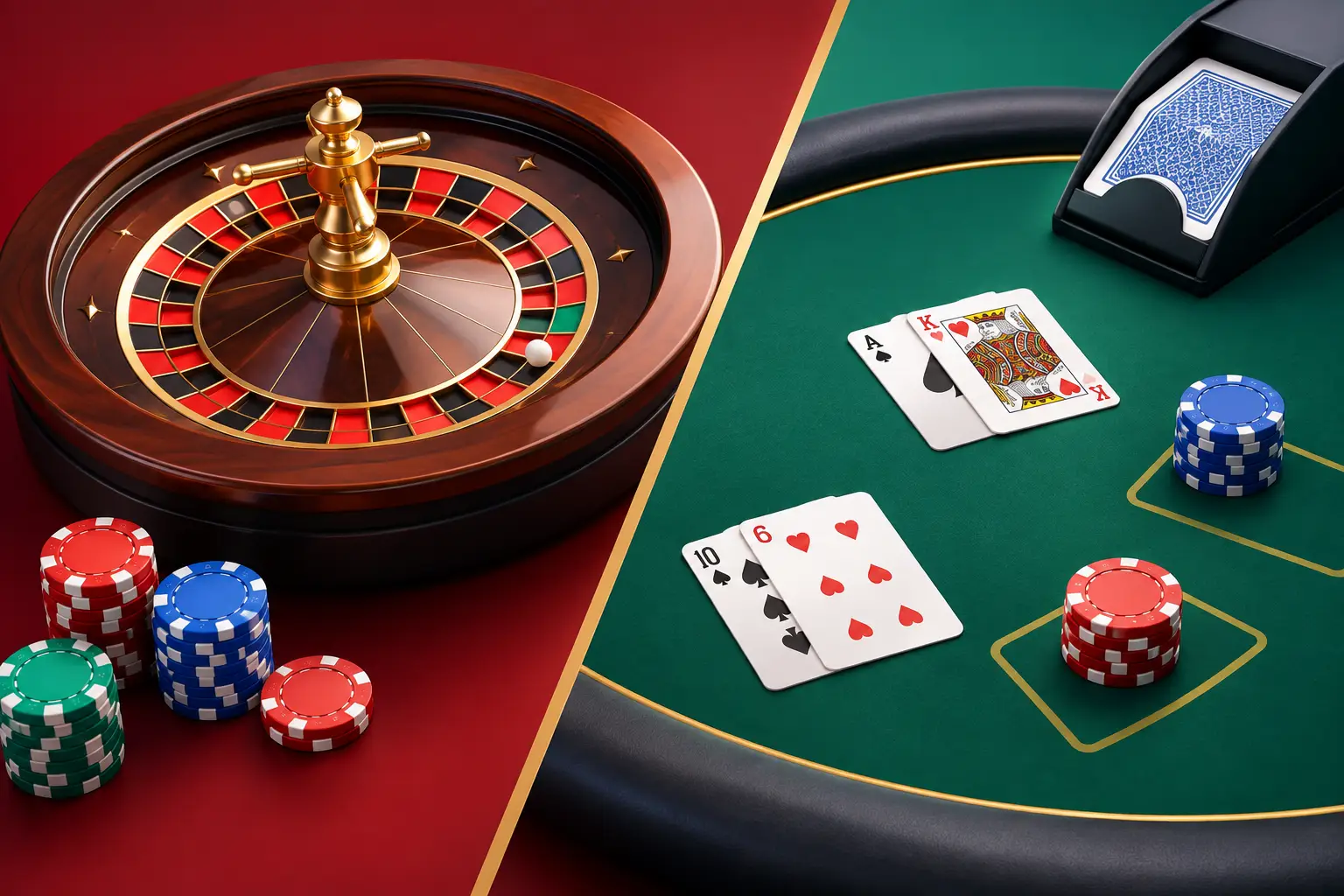
The difference between roulette versus blackjack odds can show up faster than most players expect. A few spins on a wheel may feel simpler, while blackjack asks you to make decisions every hand. But when the goal is getting more entertainment value from a real-money bankroll, the math behind each game matters far more than the pace of the table.
Blackjack generally offers a lower house edge than roulette, but only when you use sound basic strategy and choose favorable table rules. Roulette is easier to learn, easier to play casually, and can deliver larger single-spin payouts on inside bets. The better choice depends on whether you prefer strategy, speed, volatility, or a straightforward game with no decisions to make.
Roulette Versus Blackjack Odds at a Glance
The house edge is the casino’s mathematical advantage over time. It does not predict what happens in one session. A player can win quickly on either game, and a long session can move in either direction. It does show which game is designed to retain less of each dollar wagered across many bets.
| Game and rules | Typical house edge | What drives the result | |—|—:|—| | Blackjack with correct basic strategy | About 0.5% | Player decisions and table rules | | European roulette | 2.70% | One zero on the wheel | | French roulette with La Partage | 1.35% on even-money bets | Half of an even-money loss returned when zero lands | | American roulette | 5.26% | Both 0 and 00 are on the wheel |
For pure mathematical efficiency, blackjack is usually ahead. A 0.5% edge means that, in the long run, the expected casino advantage is about 50 cents per $100 wagered. On European roulette, it is $2.70 per $100 wagered. American roulette carries a much higher cost because the extra double-zero pocket reduces the chance of winning every standard bet.
That comparison comes with a condition that many quick blackjack comparisons miss: the player must make the right decisions. If you regularly stand when you should hit, split weak hands at the wrong time, or take insurance without a specific advantage, blackjack’s edge can rise sharply. Roulette has no strategy chart to memorize. You place a bet, the wheel spins, and the stated odds apply.
Why Blackjack Usually Has Better Odds
Blackjack is unusual because your choices influence the expected return. You decide whether to hit, stand, double down, split pairs, or surrender when that option is available. Basic strategy is not a guarantee of a win. It is a decision system that identifies the play with the lowest expected loss for each player hand and dealer upcard.
For example, doubling down on 11 against a dealer’s lower card may feel aggressive, but the mathematics supports it because you are likely to improve a strong starting hand. Standing on a hard 16 against a dealer’s high card can feel safer, yet hitting is often the lower-cost decision even though you may bust. Blackjack rewards players who can separate the best long-term move from the most comfortable short-term move.
Table Rules Change Blackjack’s House Edge
Not every blackjack table delivers the same odds. Before placing a bet, check the game information for the rules that affect returns. A game that pays 3:2 for a natural blackjack is much better for the player than one paying 6:5. That payout change alone can add roughly 1.4 percentage points to the house edge.
The number of decks, whether the dealer hits or stands on soft 17, whether doubling after a split is allowed, and whether late surrender is offered all affect the math. Fewer decks are often favorable, but rules should be assessed as a complete package. A multi-deck game with strong payouts and flexible doubling options may be more attractive than a single-deck game with restrictive conditions.
Card counting is frequently mentioned in discussions of blackjack odds. In theory, it can shift the edge in limited situations, but it requires disciplined tracking, accurate bet changes, excellent basic strategy, and a game with suitable rules and penetration. It is not a practical plan for most online RNG blackjack games, where cards are commonly shuffled after each hand. For most players, basic strategy is the relevant tool.
Roulette Odds Depend on the Wheel You Choose
Roulette is built around fixed probabilities. The wheel does not remember previous spins. A run of red does not make black “due,” and several zero results do not signal that the next spin will avoid zero. Every spin is independent, whether you play a live dealer table or an online RNG version.
On a European wheel, there are 37 pockets: numbers 1 through 36 plus a single zero. A straight-up bet on one number pays 35:1, but the actual chance of winning is 1 in 37. The payout is slightly below the true odds needed for a perfectly fair game, and that gap creates the 2.70% house edge.
American roulette has 38 pockets because it adds 00. Standard payouts remain the same, so the player’s probability drops while the reward does not increase. When comparing tables, selecting a single-zero wheel instead of a double-zero wheel is one of the clearest decisions you can make.
Outside Bets Feel Safer, but the Edge Remains
Red or black, odd or even, and high or low bets cover 18 numbers on a standard wheel. They offer nearly even-money outcomes, but zero and 00 are not red, black, odd, even, high, or low. On European roulette, an even-money bet wins 18 of 37 possible outcomes. On American roulette, it wins 18 of 38.
Outside bets can create a smoother experience because they win more often than straight-up or split bets. They do not reduce the standard house edge. A $10 bet on red and a $10 straight-up bet on a single number on the same European wheel both face the same 2.70% edge over the long term. What changes is volatility: the single number pays much more but misses far more often.
French roulette can be the stronger roulette option if it includes La Partage or En Prison. These rules apply to even-money bets when zero lands. La Partage returns half the stake immediately, lowering the house edge on qualifying bets to 1.35%. The rule does not normally apply to inside bets, so read the table rules before assuming every wager receives the reduced edge.
Strategy, Pace, and Bankroll: The Practical Difference
The game with the lower house edge is not automatically the best fit for every session. Blackjack takes more attention. You need to follow the hand, understand the dealer’s upcard, and make a decision before the round continues. For players who enjoy having control and learning a repeatable approach, that involvement is a major advantage.
Roulette is more direct. Choose a chip value, select your numbers or outside bets, and wait for the result. This makes it approachable for new players and convenient for anyone who wants a fast table-game session without studying a chart. Live roulette also has a social, visual appeal that software blackjack may not match.
Pace changes bankroll pressure, too. A fast online blackjack table can deal many hands in a short period, especially if you play alone. Rapid roulette rounds can also add up quickly. Lowering your bet size is often more useful than chasing a particular pattern. A modest stake lets you experience more rounds and reduces the impact of a short losing streak.
Avoid systems that claim to overcome the house edge. The Martingale system, for example, asks players to double their bet after every loss. It can produce small wins until a losing sequence collides with table limits or your bankroll. The wheel’s odds never improve because you have lost several times in a row.
Choosing the Right Game for Your Style
Choose blackjack if you want the strongest standard odds available in a casino table game and are willing to use basic strategy consistently. Look for 3:2 blackjack, clear rules, and a betting level that fits your session budget. The goal is not to force every hand into a win. It is to make the mathematically sound play without chasing losses.
Choose European or French roulette if you prefer simple bets, a visually engaging game, and the excitement of larger payout options. Avoid double-zero roulette when a single-zero alternative is available. If you favor red/black or other even-money bets, French roulette with La Partage can be especially worth considering.
At AiPlay Casino, players should check each game’s information screen before joining a table, particularly for blackjack payouts, dealer rules, roulette wheel type, and any live-table minimums. A secure, convenient casino experience is stronger when you understand the numbers before the first wager.
The smartest choice is the game you can enjoy within a clear budget and play with realistic expectations. Blackjack rewards preparation; roulette rewards simplicity. Set a limit before you start, treat every wager as entertainment spending, and stop when the session is no longer fun.